Thinking About LLM Applications: Discovering Your Unknowns
References:
“Finding Your Unknowns”: https://claude.com/blog/a-field-guide-to-claude-fable-finding-your-unknowns
“Understanding Is the New Bottleneck”: https://www.geoffreylitt.com/2026/07/02/understanding-is-the-new-bottleneck
I’m planning to put together a collection of reflections on LLM applications. I’ve noticed that since the advent of AI, opportunities for thinking have become fewer — yet thinking is precisely our most precious asset. Thinking helps us discover the essence of things and broadens our cognition.
In the AI era, the most important thing is to outsource as little of your thinking as possible.
When I use Agents to complete tasks, the pattern I use most is: Plan → Execute → Verify. I find this pattern quite effective.
During the execution phase, I treat the Agent as a “tool” — a powerful execution tool.
During the planning phase, I prefer to think of the Agent as a “thinking partner” — collaborating with me to arrive at the best solution. The most critical part of this process is discovering many unknown territories through discussion, and getting them understood and clarified.
In the process of understanding and practice, you’ll find many real-world gaps — many things don’t match what you thought. I believe these gaps are the unknown territories.
When a model executes a task based on an initial understanding, it makes its best guess and runs with it. As the execution grows longer, the unknowns increase exponentially, and the final result diverges massively from our original intent, causing task failure.
Previously, we’d simply attribute this to expression — to prompt design. But as models’ reasoning capabilities improve, the problem may be deeper: I don’t have a complete understanding of the task, there are many unknown factors I can’t clarify, so I don’t know what to express.
One more thing to note: don’t hope for one perfect plan and then execute. During execution, unknown factors will also emerge, and we need to adjust our understanding and plan accordingly.
1. What Are Your Unknowns?
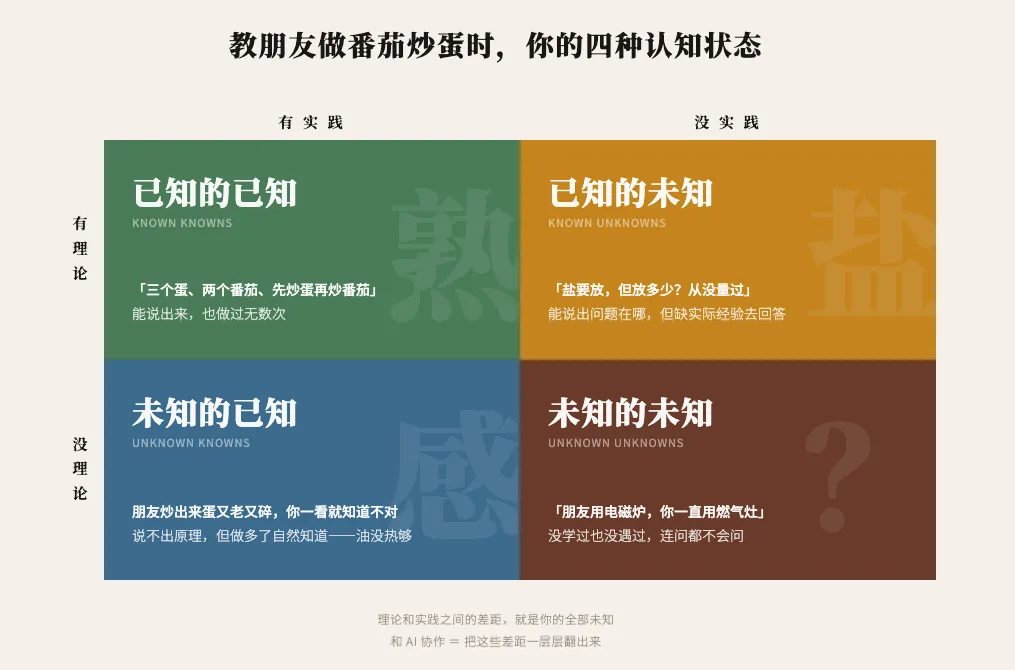
I prefer to understand unknowns through the lens of understanding and practice:
Known understanding + Known practice: I have my own understanding of the task and have done it before, so I can clearly express it in the context I give the model.
Known understanding + Unknown practice: I have a rough idea, but the specific details are unclear. I’ll have the model explore and clarify — for example, I know every application has permission design, but I don’t know the specific details and differences of permission design in this particular scenario.
Unknown understanding + Known practice: I’ve seen this thing before, but I haven’t systematically summarized it — for example, I’ve seen beautiful website designs, but I can’t articulate what makes them beautiful.
Unknown understanding + Unknown practice: I don’t know and haven’t done it. This is the purest form of unknown.
Here’s a simple everyday example that better illustrates these four situations:
In the relationship between understanding and practice, I follow a general pattern: practice, then understand, then practice again, then understand again — in a continuous cycle.
In each cycle of practice and understanding, we discover more unknown territories, and both our understanding and practice advance to a higher level.
For example: once you’ve had a simple practice with something, you’ll summarize general patterns — what we call experience. Next time you encounter something similar, you’ll start from that experience.
But in the process, you’ll find the experience is slightly off — the approach doesn’t work. You’ll learn a lesson, and that lesson can be understood as an “unknown territory.” Then you’ll correct your understanding and practice again, eventually getting it done.
Of course, we can also observe that Agents are increasingly shifting from redundant reasoning toward Action-based validation through practice. Redundant reasoning, based on users’ simple inputs to guess intent, falls into a theoretical black box — cycling endlessly without breaking free.
2. Some Concrete Patterns
When guiding the model, if instructions are too specific, the model’s reasoning quickly narrows and it’s hard to discover things we haven’t noticed. If instructions are too broad, the model will likely follow best practices, which may not fit our current task.
As the Anthropic blog puts it:
The most important part of this process is giving Claude your starting context. For example, tell it your current thinking progress; explain your familiarity with the problem and codebase; and let it collaborate with you as a thinking partner.
2.1 The Blind Spot Pass
When you receive a task and have absolutely no idea what to do — no clues at all. For example, adding a new feature to a codebase you’re completely unfamiliar with, for a project you know nothing about.
Your first step should be understanding your blind spots. Be honest with the model about your task goal and your cognitive starting point. Don’t force yourself to ask specific questions — that would prematurely narrow the execution path or lead it in the wrong direction.
You can simply say: “I need to do X, but I’m completely unfamiliar with this domain. Help me map it out.”
I like using terms like “blind spot audit” and “unknown unknowns” directly. Letting Claude know your identity and knowledge background usually helps it find the best way to collaborate with you.
For example: “I want to add a new authentication method to the codebase, but I know nothing about the auth module. Help me understand the overall situation.”
The model will use its knowledge and retrieved context to lay out the key concepts and decisions in this domain. At that point, you’ve rebuilt your cognition — moving from an “unknown unknown” state to a “known unknown” state. Now you can ask more specific questions.
Prompt example:
- “I don’t know what color grading is, but I need to color-grade this video. Can you help me understand my unknown unknowns in color grading so I can ask better questions?“
2.2 Brainstorming and Prototyping
This method works when you’re in an “unknown knowns” state for a domain: you have judgment about outcomes, but no clear theory about the process.
The most typical example is visual design — when the model generates four directions, you can instantly tell which one is good and which one is wrong.
But if asked to describe what “good” looks like in advance, you can’t articulate it. Your judgment comes from accumulated past experience — it’s real, it just hasn’t been systematically recognized.
In these situations, during collaboration with the model, I focus on describing the task background and introducing my cognitive state, which prevents the model’s reasoning from narrowing too early. Through continuous brainstorming, unexpected results emerge, and I also build explicit cognition.
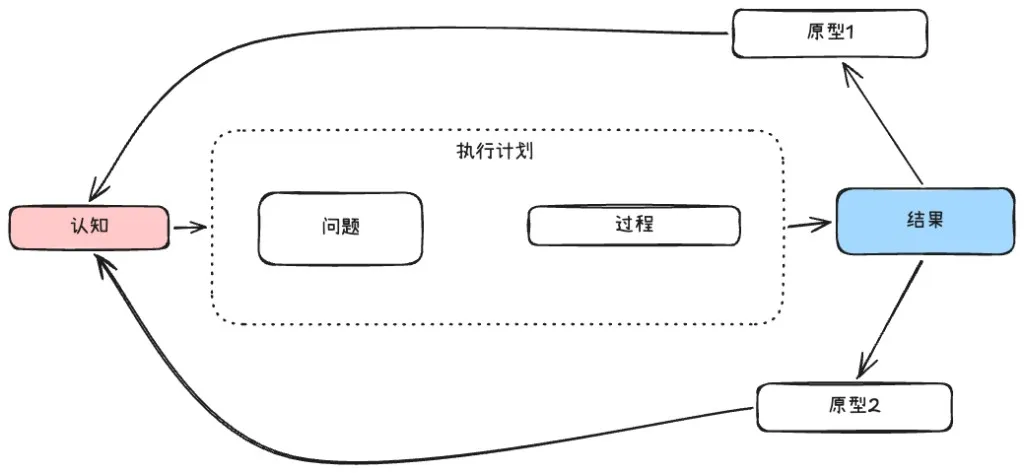
After a few rounds, my understanding of the task is much clearer than at the start. Writing execution plans and defining specific approaches at this point is far more accurate.
So brainstorming and prototype validation are essentially a process of converting practical judgment into theoretical cognition.
Prompt examples:
“I want a dashboard to display this data, but I have no visual aesthetics sense and don’t know what it could look like. Please make me an HTML page with 4 radically different design directions so I can give feedback on them.”
“My rough problem is: users churn after onboarding. Search the codebase and brainstorm 10 places we could intervene, from lowest cost to most ambitious. I’ll tell you which ones resonate.”
2.3 Interviews and Quizzes
Interviews and quizzes are different. Interviews happen before execution, supplementing your cognition. Quizzes happen after execution, verifying whether results match your expectations and understanding what the model did.
After thorough brainstorming, interviews let the model ask me about anything unknown or ambiguous. When requesting an interview from the model, provide as much background information as possible to guide its questions.
A great interview prompt example: “Ask me one question at a time about anything ambiguous, prioritizing questions where my answer would change the architecture.”
Quizzes come after the model has executed tasks over an extended period. During execution, the model may have made adjustments based on actual conditions — this is why implementation notes exist (for tracing the execution process).
After reading code diffs and trying to understand the model’s execution process, we can ask the model to quiz us about those changes.
A good quiz prompt example: “I want to make sure I fully understand everything that happened in this changeset. Give me an HTML report about these changes for me to read and understand, including context, intuition, and what was done, with a quiz at the bottom about these changes that I must pass.”
Quizzes help you understand the codebase, and that understanding is the key to driving creativity.
Your understanding of the system is part of your ability to come up with the next idea to push it forward.
You need rich concepts in your mind to think creatively and fluently about how to advance something. If you lack that fluency, your ability to participate in the project is significantly limited.
2.4 Implementation Notes
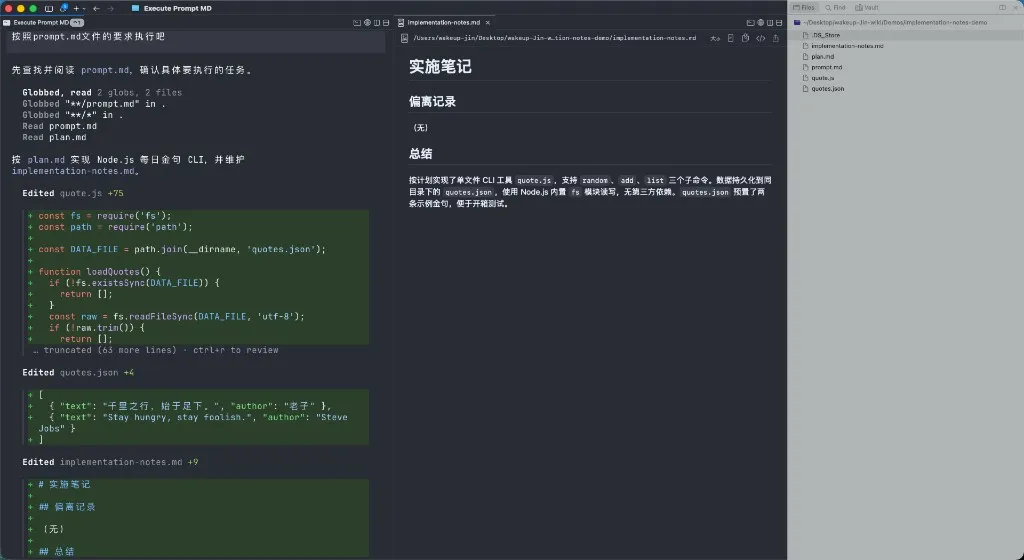
I have the model maintain something like an implementation log while executing the plan, recording key decisions and execution paths during the process.
No matter how perfect our plan is, reality is always complex. The model may make adjustments during execution, and it can record those adjustments in the implementation notes document, which I can later use for retrospection and summarization.
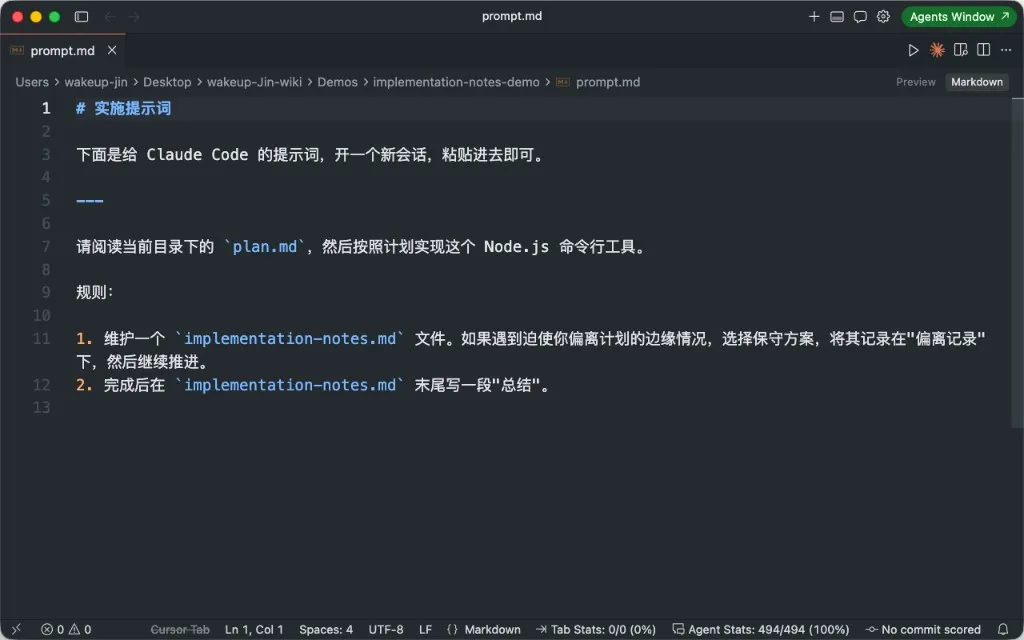
Here’s my prompt:
Here’s the execution process:
A good prompt example: “Maintain an implementation-notes.md file. If you encounter edge cases that force you to deviate from the plan, choose the conservative approach, log it under ‘Deviations,’ and keep moving.”